Service
Oil & Gas Pipeline Flow Analysis
Predict pipeline performance. Understand pressure losses. Evaluate thermal behaviour.
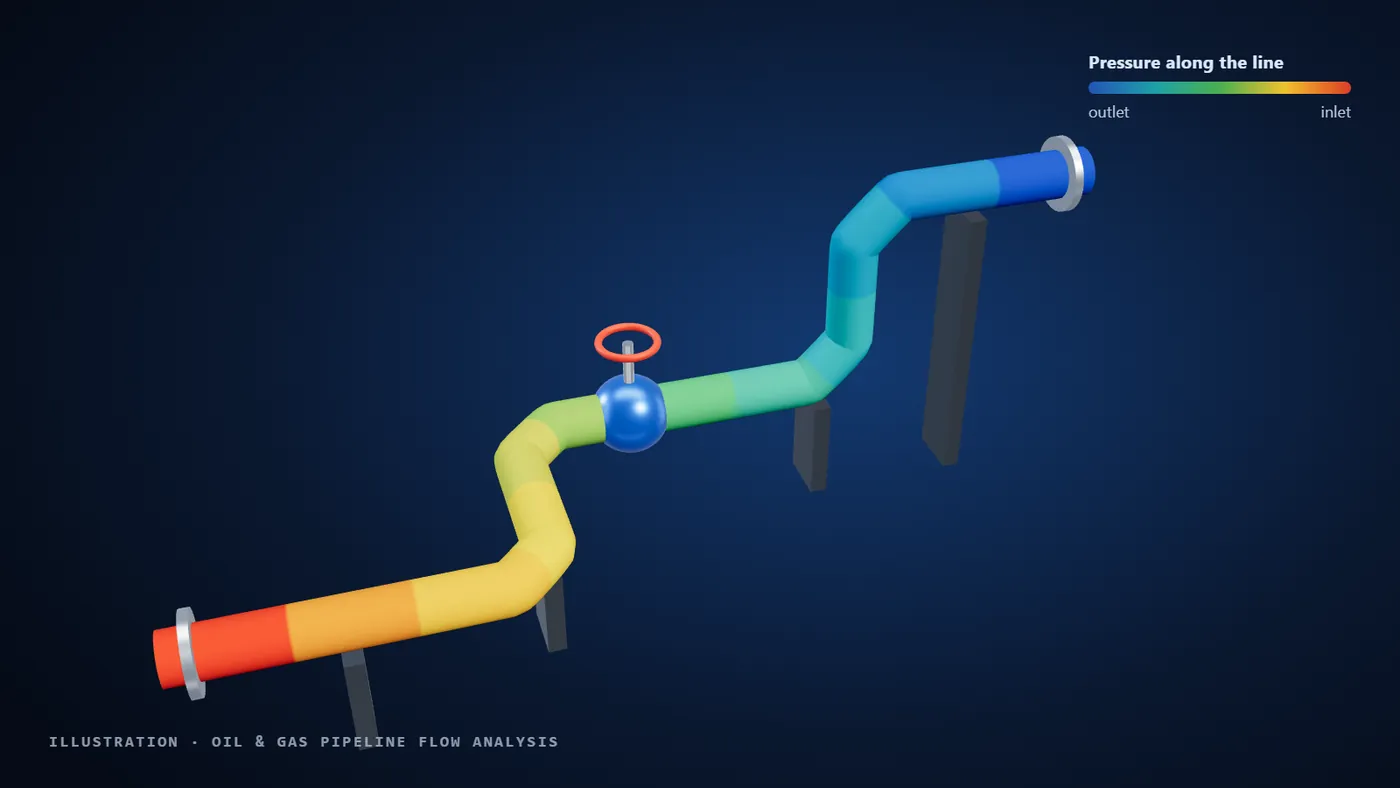
We analyse gas and liquid flow through pipelines and process piping systems, so you know the outlet pressure and temperature, where the losses are, and which pipe size or insulation option works best.
What we do
- Calculate pressure drop along straight pipe sections
- Evaluate the effects of pipe diameter, length, roughness, and material
- Assess bends, valves, reducers, tees, and other fittings
- Estimate outlet pressure and temperature under defined conditions
- Evaluate velocity, mass flow, density, and volumetric flow
- Assess gas-property changes with temperature and pressure
- Analyse heat transfer through pipe wall, insulation, and surroundings
- Evaluate blower or compressor requirements when equipment data is available
- Compare pipe sizes, insulation arrangements, and operating conditions
- Support flow-distribution analysis in branched networks
Typical applications
- Industrial flue-gas pipelines and exhaust ducts
- Natural gas and other process-gas pipelines
- Oil and liquid process piping
- Industrial ventilation and gas-handling systems
- Blower discharge and suction piping
- Thermal and pressure-loss assessment of long pipe runs
Engineering problems we help solve
- What will the outlet pressure be after a long pipeline?
- How much pressure is lost through the pipeline and its fittings?
- How does pipe diameter affect velocity and pressure drop?
- How much will gas temperature change along the pipe?
- What is the effect of ambient temperature and insulation?
- Are the specified blower or compressor conditions sufficient?
Our approach
- 01Operating dataFluid properties, flow rates, pressures, temperatures, and layout.
- 02Method selectionPipe-flow calculation, CFD, or a combination as the problem needs.
- 03AnalysisCalculate losses, outlet conditions, and thermal behaviour.
- 04Scenarios & reportCompare options and document assumptions and limits.
What you receive
- Predicted outlet pressure and temperature
- Pressure-drop breakdown along the line and through fittings
- Velocity, density, and flow-rate calculations
- Heat-loss or heat-transfer estimates
- Comparison of pipe diameters and insulation options
- Operating-scenario assessment
- Report with assumptions, property models, and limitations
Tools & technology
ANSYS FluentEngineering pipe-flow calculationsProcess property models
Who it's for
Oil & Gas
Energy & Process
Heavy Engineering
Scope note: these are engineering flow and thermal analyses. They are not certified pipeline-integrity, hazardous-area, or process-safety assessments.
Frequently asked questions
Do you always use CFD for pipelines?
No. Standard pipe-flow calculations are often enough. CFD is used where local flow behaviour, complex fittings, or heat transfer need a closer look.
What data do you need?
Pipe layout and sizes, fittings, fluid composition or properties, inlet conditions, flow rate, and ambient or insulation details.
Ready to start?