Service
Static Structural Analysis
Evaluate strength, stiffness, and structural integrity under defined operating loads.
Most structures spend their life under steady or slowly changing loads. Static analysis confirms they are strong enough, stiff enough, and not carrying more material than they need.
What we do
- Analyse components under steady or slowly varying loads
- Calculate stress, strain, displacement, and support reactions
- Evaluate forces, moments, gravity, and pressure loads
- Assess bolted connections, supports, frames, and assemblies
- Evaluate behaviour under specified operating and load cases
- Compare results against material properties and acceptance criteria
Engineering problems we help solve
- Will a bracket withstand the specified load?
- Will a machine frame deflect beyond acceptable limits?
- Are stresses around mounting points or connections excessive?
- Can a component meet stiffness requirements with less material?
- Will a support structure carry the expected equipment loads?
- How will changing thickness, geometry, or material affect performance?
Our approach
- 01Load casesDefine forces, moments, pressures, and support conditions.
- 02Model & meshBuild the structural model within the agreed scope.
- 03SolveCalculate stresses, deflections, and reactions.
- 04Compare & optimiseCheck against criteria and compare design options.
What you receive
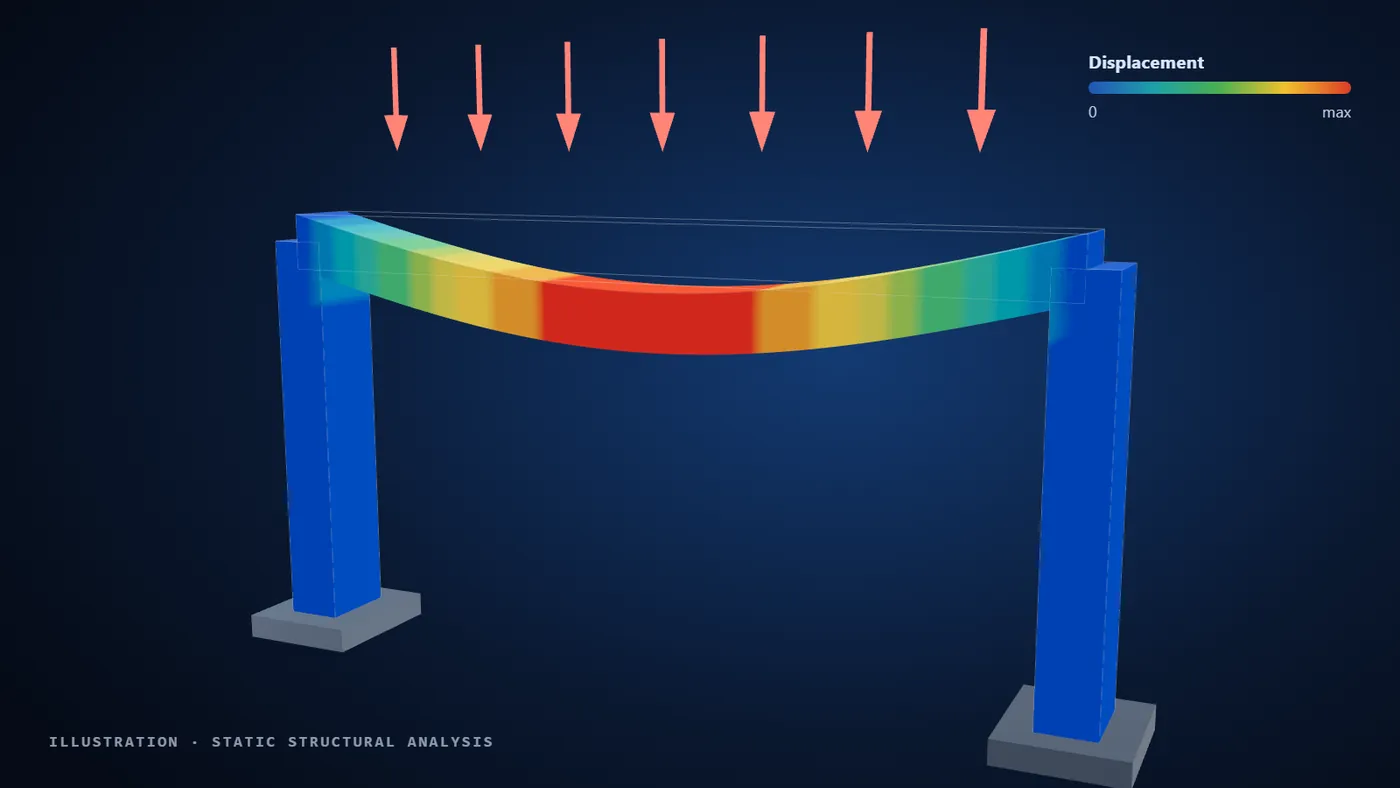
- Static stress and deformation plots
- Reaction-force and load-distribution results
- Critical-location assessment
- Design comparison and optimisation recommendations
- Report documenting boundary conditions, assumptions, and acceptance criteria
Tools & technology
ANSYSAbaqusHyperMeshSolidWorks Simulation
Who it's for
Automotive
Heavy Engineering
Industrial Equipment
Shipbuilding
Frequently asked questions
When is static analysis enough?
When loads are steady or change slowly compared with the structure’s natural frequencies. If loads vibrate, impact, or change quickly, dynamic analysis is the right tool.
Can you compare several design options?
Yes. Comparing thickness, geometry, or material options side by side is a standard part of the study.
Ready to start?